

Specialist in Adana for Psoriasis (Psoriasis) disease and its treatment. Dr. You can make an appointment with Pınar Bozkurt dermatology clinic.
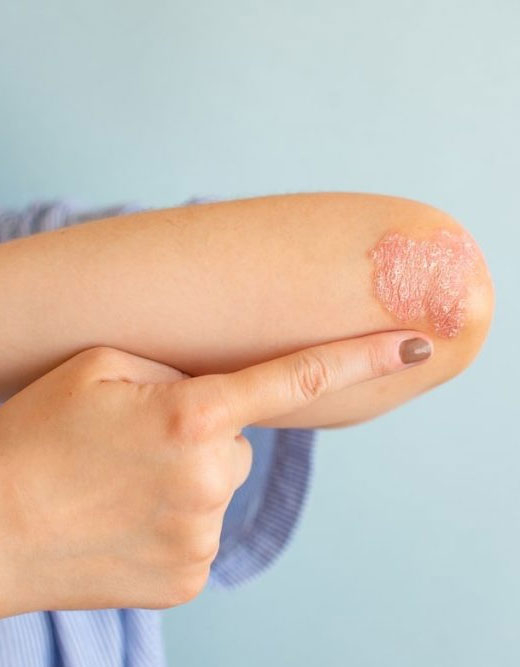
Psoriasis is a chronic skin disease that is common in the community and progresses with exacerbations and improvements. The exact cause is unknown; immune system, genetic and environmental factors are thought to be effective. Environmental factors (throat infections due to streptococci), some drugs (cortisone, lithium, some blood pressure medications, aspirin, etc.), excessive alcohol intake, smoking, scratching, pus and stress can trigger the disease. The disease is not contagious. Psoriasis vulgaris is the most common clinical type, it is usually seen as a sharply circumscribed rash with psoriasis (silver) scaling on which the disease is named. It is most commonly located on the knee, elbow, scalp and coccyx. Inverse psoriasis, palmoplantar psoriasis, guttate psoriasis, erythrodermic psoriasis, pustular psoriasis are the other types. Joint and nail involvement can be seen.
Especially in those with severe psoriasis, the susceptibility to cardiovascular diseases may increase and diabetes is common.
Psoriasis can be controlled with appropriate treatment and long-term improvement can be achieved. Drugs and behaviors that may exacerbate the disease should be avoided. In mild cases, primarily local treatments are used (drugs that remove dandruff on the skin surface, creams with cortisone, anthralin, calcipotriol, calcineurin inhibitors). In severe cases, methotrexate, cyclosporine-A, acitretin (synthetic vitamin A) and phototherapy are used. If there is no response to these, biological agents (adalimumab, etanercept, infliximab, ustekinumab, etc.) can be selected.
Psoriasis is a skin disease with exacerbations seen in 1-3 of every 100 people. It occurs equally in both sexes and can occur at any age. It occurs most frequently in the 20-year-old age group. Although there is a genetic predisposition, it is not seen in every member of the family. Environmental factors can increase it. It is usually distinguished by sharply circumscribed pink-red plaques, which are mother-of-pearl-like white-gray flakes that give the typical appearance of the disease.
What are the causes of psoriasis?
Although the exact cause is unknown, it is thought to occur when the immune system affects the epithelial cells unusually under the influence of environmental factors in genetically susceptible individuals. Environmental factors such as microbial diseases (throat infection, etc.), drugs (lithium, some blood pressure medications, aspirin, etc.), stress, mechanical irritation (rubbing, scratching), sunburn can have an increasing effect.
What are the symptoms of psoriasis?
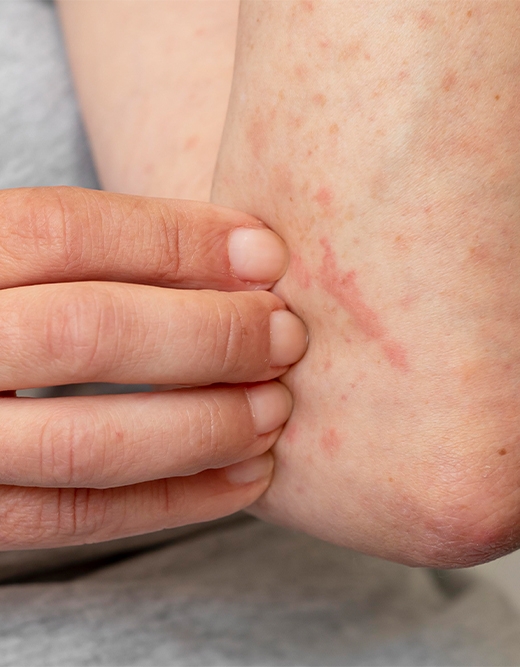
The most typical symptoms of psoriasis are sharply circumscribed, vivid red-colored lesions with psoriasis-colored crusts on them, especially in areas of impact such as knees and elbows. These lesions can also occur in the scalp, nails, and genital area.
If left untreated, it can thicken over time and make movement in the hands and feet difficult. It does not cause baldness, but if the disease is severe, it can increase hair loss. Psoriasis can only affect the nail. The most common findings are pinhead-sized pits, thickening of the nail, discharge, and yellow discoloration. Sometimes swelling and redness may develop around the nail.
It is also known that psoriasis does not only affect the skin today, especially when it starts at an early age, it affects the joints, cardiovascular system, causes diabetes and obesity. Therefore, it is also important to detect and treat accompanying diseases during the follow-up and treatment of patients. In addition, the disease rarely affects the joints. Swelling and pain occur in the joints in 30% of the cases. Psoriatic arthritis needs effective treatment because it causes joint damage and chronic pain.
• Joint pain with increased warmth, redness and swelling in the joint
• Morning stiffness with back pain lasting an hour or more
• Restriction in the movements of the joints are the main symptoms of psoriatic arthritis.
Who gets psoriasis?
It is estimated that psoriasis affects 125 million people worldwide. Its incidence is around 2-3%. One third of the cases have psoriasis in their first-degree relatives. If a single parent has psoriasis, the risk for the child is 14%, and if a double parent has it, it is 41%.
Psoriasis occurs less frequently in children. It occurs before the age of 10 in 10% of the pediatric patients and before the age of 2 in 2% of them. It is thinner and lighter crusted, more itchy. It settles on the face, scalp and folds. It can affect the diaper area and armpit.
Due to the fact that psoriasis progresses with some additional health problems, very good follow-up and education in terms of lifestyle are necessary, especially for those who start under the age of 20.
Does psoriasis occur in the same way in every patient? Does it mix with other diseases?
Sharply circumscribed ova, typically on the knees and elbows, on the scalp, on the lower back
L-shaped, pink, red, white, psoriasis-like flaking plaques are formed. Sometimes, similar lesions occur without scaling in areas such as the groin, armpits and under the breasts in the folds, and should be differentiated with diaper rash and eczema. It can only be seen on the soles of the palms and can be confused with fungal disease.
Small red flaking plaques in the form of drops on the trunk, arms and legs may appear suddenly in children and adolescents after upper respiratory tract infection, and regress more quickly with appropriate treatment.
Psoriasis can be seen in the form of a pimple-like rash on the red background of the palms of the feet and soles in a certain area or in the form of acne-like rashes on a widespread red plaque all over the body.
Less commonly, it may be widespread throughout the body.
Small pits on the nails, separation, yellowish staining, signs of thickening of the nail plate can be seen. Joint disease can be seen in 20 percent of psoriasis patients. Most commonly, the hand finger joint and lumbar region are involved. If there is low back pain, morning stiffness, swelling and redness in the joint area, joint psoriasis is investigated.
Is testing required for diagnosis? Does it accompany other diseases?
Usually, no additional testing is done for diagnosis. If it is not typical, a skin biopsy may be required to distinguish it from other skin diseases that may be confused. A blood test may be requested to look for factors that may increase its severity and to use safe drugs before some treatments. People with severe psoriasis can be followed up in terms of metabolic diseases, diabetes, cardiovascular diseases. Obesity and bowel disease can sometimes accompany.
How is psoriasis treated?
Psoriasis is a lifelong disease. It can be kept under control with precautions and appropriate treatment. Psoriasis can cause social and psychological problems in the person. Therefore, it is very important to recognize the disease and to avoid triggers. Early diagnosis will make it easier to control the disease. If the lesions involve more than 10% of the skin, phototherapy or systemic treatment is absolutely necessary. Being content with creams only creates difficulties in disease control and is not helpful in preventing accompanying diseases.
The aim of treatment is to avoid aggravating factors (not to irritate, not to rub, etc.), to provide long-term well-being and not to cause side effects while healing as soon as possible. The same treatment is not used for every patient. Treatment is planned with a certain algorithm. The extent of the disease, the age of the patient, compliance with the treatment, previous drugs are important in the selection of treatment. In a limited area, creams and moisturizers are used.
If there is more widespread disease, phototherapy, drugs containing synthetic vitamin A, some cancer drugs and biological treatments are used if there is joint disease or in resistant patients at a later stage, although they do not have cancer itself.
To date, no treatment for the cause of psoriasis has been found, but there have been very important developments and treatment expectations have increased from 50% to 90%. With treatment, skin symptoms can disappear completely without leaving a trace. With appropriate treatments, periods of well-being, which is almost asymptomatic, can be experienced.
In addition to medical treatment, it is important to eat a healthy diet for life in chronic diseases. Apart from this, there is no special diet directly related to the disease. Unnecessary food bans should be avoided. In addition, quitting smoking, reducing alcohol consumption and regular exercise are essential.
Psoriasis does not go away on its own and if effective treatment is not applied, the negative effects on people's lives may continue. Please do not apply all the information about the treatment without consulting your dermatologist and get information about treatment options. Any method that is far from scientific evidence should not be used in the treatment of the disease. On the contrary, these methods can sometimes worsen the situation. Do not forget that controlling the disease is only possible with good communication with your doctor.
Is psoriasis contagious?
Psoriasis is definitely not contagious. It is not transmitted by the patient himself, by contact from one area to another or to another, by using common items.
What is the course of psoriasis?
Exacerbations progress with periods of recovery. Symptoms and severity can be variable.